Posts

Showing posts with the label Soviet Union

The COVID-19 Pandemic – A Year Later
Image
  My very short blog post which was originally published in January under the title, " 'The health of the individual is the concern of society as a whole' - Defeating Disease ," has been edited, expanded upon, and republished under a new title and can be found on New Power  by clicking here . It has been expanded quite significantly so that it is now a full-length OP-ed and reflection. The COVID-19 global pandemic is now in its second year at the time of this writing.

'The health of the individual is the concern of society as a whole' - Defeating Disease

Image
"Comrades, it is impossible to imagine the dreadful situation in the typhus regions, where the population is broken, weakened, without material resources, where all life, all public life ceases. To this we say, “ Comrades, we must concentrate everything on this problem. Either the lice will defeat socialism, or socialism will defeat the lice!” " - V.I. Lenin, "Seventh All-Russia Congress Of Soviets." 5-9 December 1919 These remarks by Lenin were made during a time when the Soviet Republic, in it's very early days, still had a decrepit and severely neglected medical system, and an impoverished population that was overwhelmingly in ill health. All of these things were inherited from the old Tsarist regime. In 1918, months after the Bolsheviks successfully seized power, the Spanish Flu had reached Russian shores, largely due to the fact that WWI Russian prisoners of war had brought the disease home with them after being released by Germany. They saw 150 Spanish Flu...

Soviet Holiday Images

Image
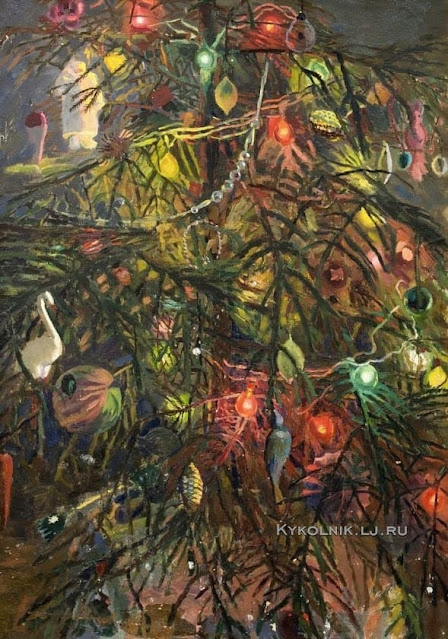
 1. Soviet New Year tree painting, 1935. 2. Soviet New Year tree painting, 1950. 3. Soviet 1950s New Year's greeting card. 4. "In New Year," (1945) by artist Churabo Nikolai Dmitrievich.  5. A 1938 holiday poster which says, "Thank you comrade Stalin for our happy childhood!" 6. "Happy New Year!" Soviet postcard, 1953. 7. Vintage 1941 Soviet New Year greeting card with Ded Moroz (Grandfather Frost). Presumably in commemoration of the Red Army's successes and victories in defeating Fascism during the Second World War. 8. New Year greeting card commemorating the Soviet space program. Unknown year, possibly 1960's or 1970's. 9. "Christmas Tree Bargaining," (1918) by artist Boris Kustodiev. 10. Vladimir Lenin and a gathering around a New Year tree. Made several years after Lenin's death. Unknown year, possibly the mid-1930's.

Soviet Health and Medicine - History in Pictures

Image
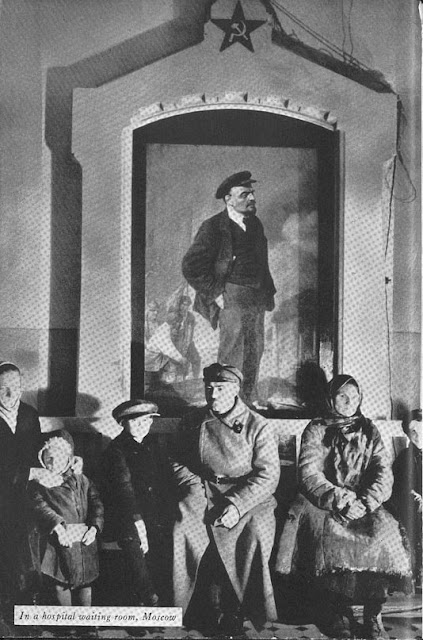
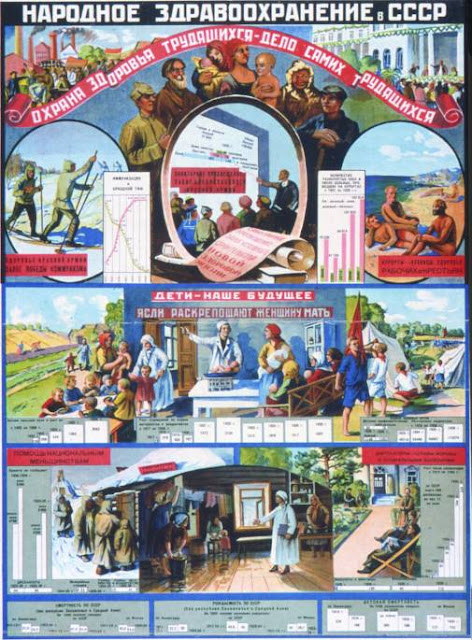
1) Sampled images from Sir Arthur Newsholme's  Red Medicine: Socialized Health in Soviet Russia   (1933): In a hospital waiting room, Moscow. Photograph by Margaret Bourke-White. Compulsory vaccination on collective farm in Turkmenistan. Photograph by Soviet Photo Agency. Diphtheria immunization in Moscow. Photograph by Margaret Bourke-White. New polyclinic in Leningrad. Leningrad Institute for the Protection of Motherhood and Childhood. Photographs by John A. Kingsbury. In a Moscow creche. Photograph by Soviet Photo Agency. Traveling dental station in rural district near Moscow. Photograph by Soviet Photo Agency. 2) Health campaign and public education posters: "Mud and death are loyal allies,"1920. An influenza, epidemic, and disease-related poster. (*Note: Mud and dirt are the same word in Russian, грязь (gryaz'). In the context of diseases and epidemics, the word 'dirt' may be more applicable. The poster is saying to keep yourself clean as opposed to dirty...

Socialized medicine for all

Image
Compulsory vaccination on collective farm in Turkmenistan. Photograph by Soviet Photo Agency. Found in Sir Arthur Newsholme's 1932 book, Red Medicine: Socialized Health in Soviet Russia .   Despite all advances made in modern medicine, and the fact that vaccination has consistently been shown to be one of the most cost-effective ways of avoiding infection, why do irrational fears of modern medicine still persist? And since when did it become acceptable for calls for “herd immunity” and homeopathy fads, which are based in mysticism, to be presented as substitutes for defending or advocating public healthcare? Vaccines, which have historically been shown to dramatically improve human health and quality of life by helping to eradicate many diseases, should be seen as a collective and social responsibility to protect one another and millions from illness. This was exemplified by the Soviet public health system where vaccinations were made compulsory in April 1919 because “the health ...

Hiroshima, Nagasaki, and What Really Stopped Japan

Image
On August 6, 1945, the United States dropped nuclear bombs on Hiroshima. Three days later, on August 9, 1945, they did the same to Nagasaki. The atomic bombings marked the first and, thus far, the only time that nuclear weapons have been used in armed conflict. Between 129 000 and 226 000 people were killed, most of whom were civilians. It is commonly believed that these bombings forced Japan to surrender, with some proponents of this oft-repeated narrative (which contains many inaccuracies and myths) going as far as to claim that it was necessary. Contrary to that commonly held belief, it was most likely the very real possibility of a Soviet offensive taking place on the Japanese mainland, which would mean a direct confrontation with Soviet forces, that pushed Japanese leaders to surrender. And so, it was really the military genius of Stalin that helped stopped Imperial Japan -- not the atomic bombs. "..."[Y]ou can’t analyze Japan’s decision to surrender objectively ...

WWII History: Remembering the True Liberators, the Soviet Union, and Operation Bagration

Image
The Soviet Operation Bagration which began on June 22, 1944 was one of the largest offenses in scale and one of the most decisive operations in all of World War II. It dwarfed the D-Day landings in terms of scale and the significant amount of damage it inflicted upon the Wehrmacht, which helped pave the way for the Red Army’s victory in the Battle of Berlin a year later. World War II historical revisionism by the imperialist nations, but especially by the United States, has long been a staple since the Cold War era. It always manifests itself in diminishing the major contributions, achievements, and immense sacrifices of the Soviet Union — while attempting to portray the U.S. as the “heroes” who carried the full weight of the war, often exaggerating its role despite being the latecomers and having made  business deals with the Nazis  prior to joining the Allies in battle. Efforts to erase the leading role that the Soviet Union played still continue today. Whether it be the ...

Nazi Collaborators in the Baltics and Historical Revisionism

Image
Ben Norton recently published an article on The Grayzone  titled " New NATO-approved US monument honors fascist Lithuanian Nazi collaborator as anti-Soviet hero " (which I highly recommend reading). In this article, Norton comments on the monument that was recently unveiled in Chicago, which honours Lithuanian Nazi collaborator and unabashed anti-Soviet war hawk, Adolfas Ramanauskas (a.k.a. "Vanagas"). The ceremony for the unveiling, held on May 4th, honours Ramanauskas as a "freedom fighter" and a "hero", as Norton writes, Lithuania’s state-funded Genocide and Resistance Research Centre has spent the past nearly three decades fueling Holocaust revisionism by portraying Nazi-collaborating Lithuanian fascists who murdered Jews in the Holocaust as anti-communist resistance heroes, while depicting Jewish anti-fascist partisans as war criminals; and by advancing the “double genocide” theory that falsely equates Soviet atrocities with Nazi cr...

Why Is the Second International Defending Trotsky?

Image
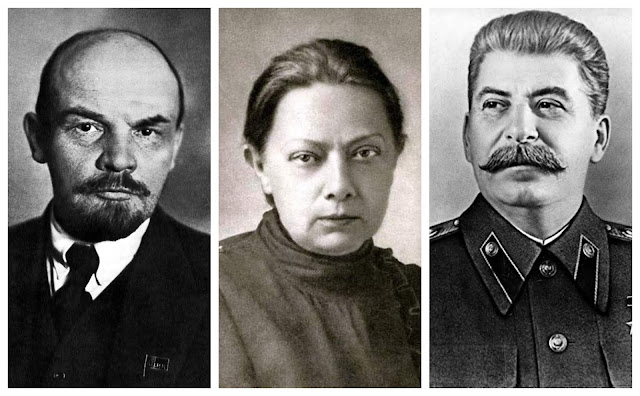
Below is an English translation of a 1936 article written by Nadezhda Krupskaya, the wife of Vladimir Lenin and a fellow Bolshevik revolutionary figure. She served as the Soviet Union's Deputy Minister of Education from 1929 until her death in 1939. This article is a reflection on Lenin, Stalin, Trotskyites, the Second International, and building socialism. She always did have a lot of respect for Joseph Stalin and it shows in this written piece; but it is not the only highlight of the article nor is it the only talking point. She talks about the hard work and dedication that went into building the Soviet Republic as well, and the early stages of developing a post-Tsarist Russia which had previously been a backward society that was seriously lagging behind in terms of technology and industry. She also provides a great deal of criticism of the Second International and its defense of Trotsky.  Now of course, neither Krupskaya nor her husband (who also criticized Leon Trotsky a g...

Afghanistan, the Forgotten Proxy War (excerpt)

Image
When it comes to war-torn Afghanistan and the role played by the United States and its NATO allies, what comes first to mind for most is the ‘War on Terror’ campaign launched in 2001 by George W. Bush almost immediately after the 9/11 attacks. And understandably so, considering that the United States and its allies established a direct “boots-on-the-ground” military presence in the country that year. Not only that, but during the Bush-Cheney years, there was an aggressive propaganda campaign being played out across U.S. media outlets which used women’s rights as one of the pretexts for the continued occupation. The irony of this, however, is not lost on those who understand that the conflict in Afghanistan has a long history which, much like Syria, stretches as far back as the Cold War era — especially when it was the United States that  provided support  for the Mujahideen in destabilizing the country and stripping away the modernizing, progressive economic and social gai...

War Criminal Profile: George Soros - Bankrolling "Peace" at Home and Terror Abroad

Image
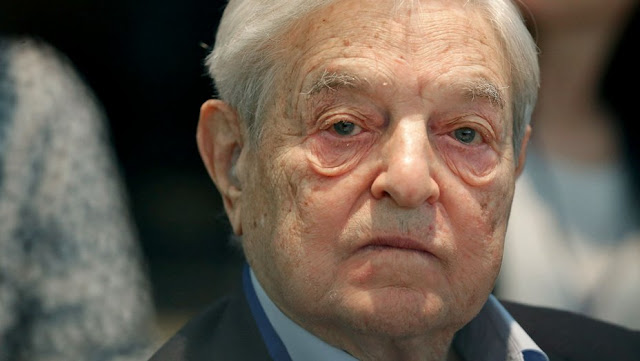
While Zbigniew Brzezinski was the mastermind behind many of the United States' foreign-meddling and regime-change projects, George Soros played the role of bankroller . Who is George Soros? George Soros is a liberal, anti-communist, hedge fund billionnaire who helped to finance CIA operations during the 1980's to bring down Soviet-aligned governments, particular those in Eastern Europe. Along with Brzezinski, he provided support for colour revolutions and proxy forces in the efforts to destabilize countries that openly defied U.S. imperialism. His targets for U.S.-led regime change projects and NATO control included: East Germany, Romania, and Czechoslovakia. He is also a trustee and a major source of funding for the Council on Foreign Relations (of which Brzezinski was also a Council member), a private organization through which Wall Street's foreign policy preferences  and interests are relayed to Washington. In other words, it is Wall Street's think tank. It...

War Criminal Profile: Brzezinski - the Godfather of Colour Revolutions and Proxy Wars

Image
A key figure in the history of U.S. foreign policy is the late Zbigniew Brzezinski, a Polish-American diplomat and political scientist who served as former President Jimmy Carter's National Security Advisor from 1977 to 1981. He was a highly influential figure in the Council on Foreign Relations. Although he was not the National Security Advisor under Ronald Reagan's presidency, he still continued to play a prominent role in enforcing U.S. foreign policy's goals in upholding Washington's global monopoly. His strategy in carrying out U.S. foreign policy consisted of using the CIA to destabilize and force regime-change onto countries whose governments actively resisted against Washington. One particular target was the Democratic Republic of Afghanistan , which was then under the progressive, anti-imperialist, and Soviet-allied government of the People's Democratic Party of Afghanistan (PDPA). Brzezinski was the architect behind the Mujahideen , which was compris...

Debunking Myths and Shedding Light on Facts about the Berlin Wall - Link Roundup

Image
An oft-misunderstood subject matter that has been made cheap fodder for imperialist and anti-Soviet propaganda is the Berlin Wall, which stood from 1961 to 1989. One of the most common misconceptions -- or rather, widespread myths -- is that West Germany was in need of protection, re-arming, and was the "victim" of "East German and Soviet aggression," and that the wall was supposedly a symbol of "communist oppression" and proof of a " totalitarian Iron Curtain". In reality, the wall was built for the defense, security, and protection of the independent East Germany (the German Democratic Republic, or GDR) from the threats coming from West Germany, who were essentially NATO proxy forces and were led by a Western-backed puppet government. There were also fears coming from the GDR of a return or resurgence of Fascism. As was already mentioned in my previous blog entry, " NATO, a Brief History ," the political partitioning of Germany w...

NATO, a Brief History

Image
Following the April 1949 signing of the Atlantic Pact and led by then-U.S. Secretary of State Dean Acheson, the North Atlantic Treaty Organization (NATO) was founded by 12 member states in London on May 18th, 1950 . Their purpose, as they claimed, was their dedication to "the preservation of peace" and to the defense of Western Europe against supposed military threats. Not only did the creation coincide with the heightened tensions of the Cold War and the political partitioning of Germany, but it also extended its invitation to West Germany to join the fold on May 9th, 1954 with the intent of re-arming it. This was a violation of the 1945 Potsdam agreement which posited that the partition of Germany was supposed to be temporary and that all of Germany was to be ' de-Nazified '; instead, we saw the development of West Germany into a Western puppet state. The Soviet Union saw the aforementioned invitation to West Germany and its re-arming as a provocation and, in th...

Imperialism, Highest Stage of Capitalism: Reflections on one of Lenin's most important works

Image
“It is characteristic of capitalism in general that the ownership of capital is separated from the application of capital to production, that money capital is separated from industrial or productive capital, and that the rentier who lives entirely on income obtained from money capital, is separated from the entrepreneur and from all who are directly concerned in the management of capital. Imperialism, or the domination of finance capital, is that highest stage of capitalism in which this separation reaches vast proportions. The supremacy of finance capital over all other forms of capital means the predominance of the rentier and of the financial oligarchy; it means that a small number of financially “powerful” states stand out among all the rest. The extent to which this process is going on may be judged from the statistics on emissions, i.e., the issue of all kinds of securities.”  —V.I. Lenin, 1916 (from Ch. III "Finance Capital and the Financial Oligarchy")  A glob...